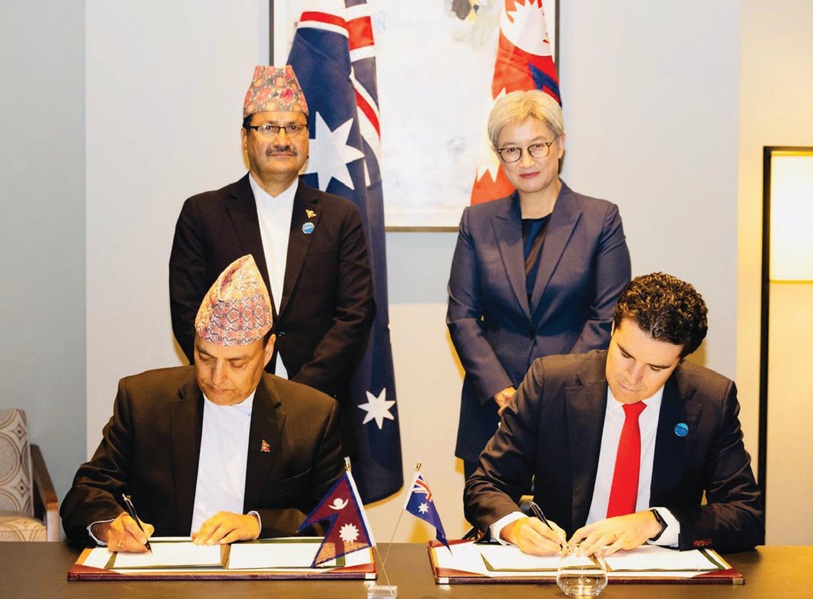

Even before the formal diplomatic ties, the Australian government and private sector were actively supporting Nepal’s socio-economic development in areas such as health, education, hydropower, forestry, agriculture, good governance, civil aviation, and animal husbandry.
Nepal and Australia established diplomatic relations on February 15, 1960. Australia opened its embassy in Kathmandu in 1984 at the chargé d'affaires level, upgrading it to ambassadorial level in 1986. Nepal established its resident embassy in Canberra in March 2007, officially inaugurated in September the same year.
Notably, even before the formal diplomatic ties, the Australian government and private sector were actively supporting Nepal’s socio-economic development in areas such as health, education, hydropower, forestry, agriculture, good governance, civil aviation, and animal husbandry.
The Nepal–Australia Parliamentary Friendship Group was first formed in the Australian Parliament in 2009. Currently, the group is actively working for Nepal’s interests under the co-chairmanship of Peter Khalil (Labor Party) and Senator Andrew Bragg (Liberal Party). Likewise, a similar group was formed in Nepal’s Federal Parliament on October 3, 2023, chaired by Nepali Congress leader Gagan Kumar Thapa.
High-Level Visits
Foreign Minister Narayan Prakash Saud visited Australia from February 8 to 13 last year and participated in the Indian Ocean Conference. Likewise, chairperson of the National Assembly, Ganesh Prasad Timilsina, led a high-level parliamentary delegation to Australia from November 27 to December 2, 2023.
Other dignitaries like former Prime Minister Madhav Kumar Nepal, Deputy PM Gopalman Shrestha, Tourism Minister Yogesh Bhattarai, Energy Minister Mahendra Bahadur Shahi, and State Minister for Finance Udaya Shamsher Rana, among others, have visited Australia at various times.
Speaker of the Australian House of Representatives, Milton Dick visited Nepal from October 3–7, 2023. Assistant Minister for Foreign Affairs, Tim Watts, paid two day official visit to Nepal from May 16, 2023. In earlier years, dignitaries such as Governor-General David Hurley (2016), MP Bob McMullan (2010), Foreign Minister Bill Hayden (1985), and Governor-General John Kerr (1975) also visited Nepal.
Bilateral Consultation Mechanism (BCM)
An agreement to establish a Bilateral Consultation Mechanism (BCM) between Nepal and Australia was signed in Canberra on July 14, 2017. The first meeting was held in Kathmandu from August 15 to 17, 2018, and the second meeting in Canberra on August 30, 2022. This mechanism has paved the way for regular discussions on bilateral, regional, and global issues.
Previously channeled through AusAID, Australian aid is now administered through DFAT (Department of Foreign Affairs and Trade). Australia’s cooperation focuses on three pillars: health security, stability, and economic recovery. Australian support was notably significant during the earthquake and the COVID-19 pandemic.
Aligned with Nepal’s poverty reduction strategy, Australian support has focused on health, education, livelihoods, good governance, peacebuilding, and human resource development. Australia has also assisted in HIV reduction, community forestry, peace processes, and micro-enterprise development.
Bilateral Relations
Nepal–Australia relations have historically been friendly, cooperative, and multidimensional. Diplomatic, economic, educational, development assistance, tourism, and people-to-people ties are growing stronger each day.

Nepal exports items such as carpets, felt products, tea, coffee, and handicrafts to Australia, while importing petroleum, dairy products, and beverages from Australia. In 2023, Nepal imported goods worth AUD 186 million from Australia but exported only AUD 16 million, reflecting a significant trade deficit.
On February 9, 2024, Nepal and Australia signed the Trade and Investment Framework Arrangement (TIFA), which is expected to strengthen trade and investment cooperation between the two countries.
In 2023, a total of 38, 789 Australian tourist visited Nepal. This number had dropped in 2021 due to the COVID-19 pandemic, but with improved conditions, tourist arrivals from Australia are expected to rise again. According to the 2021 Australian census, 122,515 people of Nepali origin reside in Australia and by mid-2023, approximately 179,000 Nepalese born people were living in Australia. Nepali students make up the third-largest international student community in Australia.
Nepal exports items such as carpets, felt products, tea, coffee, and handicrafts to Australia, while importing petroleum, dairy products, and beverages from Australia.
Nepal–Australia relations have historically been friendly, cooperative, and multidimensional. Diplomatic, economic, educational, development assistance, tourism, and people-to-people ties are growing stronger each day. Mechanisms like TIFA and high-level visits are expected to deepen and expand this relationship in the days to come.
Economic and Trade Relations
Nepal was Australia's 33rd largest trading partner with two-way trade valued at $3.9 billion in 2022/023. It ranked as our third largest trading partner in South Asia in 2022/023, behind Bangladesh at $4.1 billion and India $45.0 billion.
As Australia's third largest source of international students, Nepal is our seventh largest services exports market with education services valued at $3.4 billion in 2022/023. Nepal exported $160 million worth of goods to Australia in 2022/023, mostly in tourism.
Australia's merchandise trade with Nepal has increased in recent years with trend growth of 19 per cent over the last five years to 2022/023.
According to Australian Bureau of Statistics (ABS) trade data, Australia's merchandise trade with Nepal was worth $161 million in 2022/023, with Australian exports accounting for $145 million. Australia's exports of goods to Nepal, when including re exports via India and Singapore, are estimated to be higher than officially reported.
In 2022/023, goods imports from Nepal were worth $16 million and included carpets, cereal, and jeweler. Australia was Nepal's sixth largest source of foreign direct investment in 2021/022 and accounted for five percent of Nepal's total foreign investment.
People-to-People Links
Nepal-born people living in Australia are Australia's fastest growing and 9th largest migrant community. Nepali-Australian diaspora communities, students and alumni in Australia make important contributions and play a vital role contributing to the community and bilateral relationship. They make an invaluable contribution back to Nepal at different levels of society.
The Australian Chapter of the Non-Resident Nepali Association (NRNA) is recognized by the Government of Nepal. It helps promotes Nepali culture and supports increasing trade and investment ties between Australia and Nepal amongst other broad objectives. The second largest Nepali diaspora organization is the Federation of Nepalese Community Associations of Australia (FeNCAA).
Development Program
In 2023/024, Australia provided an estimated $27.2 million in ODA, focused on governance, climate and disaster resilience, gender equality and social inclusion. Australia's development program supports Nepal's development pathways and their graduation from Least Developed Country status in 2026.
The flagship Subnational Governance Program (SNGP) supports Nepal's transition to federalism through institutional capacity building. It clarifies functions among the different levels of government including local, provincial, and federal, facilitates dispute resolution related to the roll-out of federalism, and promotes inclusive decision-making and service delivery.
Through a Memorandum of Understanding on Water Resource Management led by Nepal's Water Energy Commission Secretariat, Australia shares lessons and expertise in areas of mutual interest such as river basin planning and governance, the energy-water nexus, climate change and disaster risk reduction.
Under a partnership with the International Centre for Integrated Mountain Development (ICIMOD), Australia helps respond to challenges faced by mountain communities in the Hindu Kush Himalayas, complementing the work of other development partners, including the Government of the United Kingdom.

Under the Australian NGO Cooperation Program, Australian NGOs in partnership with local organizations deliver more than 40 projects in Nepal in areas such as: communicable diseases, disability, disaster risk reduction, economic development, education, eye health, food security, gender, health, human rights, livelihoods, microfinance, inequality reduction and rural development.
In May 2021, Australia provided an additional $7 million to assist Nepal respond to COVID-19 for medical equipment and supplies; storage and distribution of relief supplies; coordination and other essential services.
The Australian Centre for International Agricultural Research (ACIAR) and CSIRO are active in Nepal, focusing on improved integration of soil, water, crop, livestock and forestry components of farming systems and river basin management.
Over 1,000 Nepalis have participated in the Australia Awards program to date, with alumni now in key leadership positions in government and business.
Political Overview
Following a 10-year civil war (1996-2006), in 2008, the then newly elected Constituent Assembly declared Nepal a Federal Democratic Republic, abolishing their 240-year-old monarchy. Nepal now has a President as Head of State and a Prime Minister heading the Government. Their new Constitution was adopted in 2015.
Following their 2022 Nepali general election, Communist Party of Nepal Maoist Centre (CPN-MC) Chairman, Pushpa Kamal Dahal, assumed office as Prime Minister from 26 December 2022. He formed a 10-party coalition government with the Nepali Congress Party. On 4 March 2024, Dahal ended this coalition and formed a new coalition with the CPN (UML) and other smaller parties.
Economic Overview
Nepal has a Gross Domestic Product (GDP) of approximately USD40.8 billion and a per capita annual income of USD 1,336 (2022 data). Building on GDP growth of 1.9 per cent in 2022-2023, the economy is projected to grow by 5.1 per cent in 2023 2024, on the back of stronger overseas remittances, tourism recovery and lower inflation.
In 2022, just over 52.3 percent of Nepal's GDP came from its service sector. Agriculture contributed the second largest, and eleven percent came from the industry sector. Nepal's GDP is reliant on overseas remittances. Other key components of their GDP include tourism, carpets, textiles, processed seed oils and small rice.
Nepal has been a member of the World Trade Organization (WTO) since April 2004. The WTO membership helps Nepal integrate with the global trading system. The Government of Nepal took steps to attract investment, including from foreign investors. The 3rd Nepal Investment Summit in Kathmandu on 28-29 April 2024 is an example of these efforts.
Tourism and Cultural Relations
Australian tourists are drawn to Nepal for
adventure tourism, mountain trekking, cultural
heritage, and nature exploration. Nepali handicrafts,
traditional dress, ethnic culture, and religious
tolerance have brought the two countries closer in
cultural ties. The presence of the Nepali community
in Australia’s multilingual and multicultural society is
further strengthening these relationships.
Comments are closed!